Warping Point Phoenix 13.3mm Paddle Review
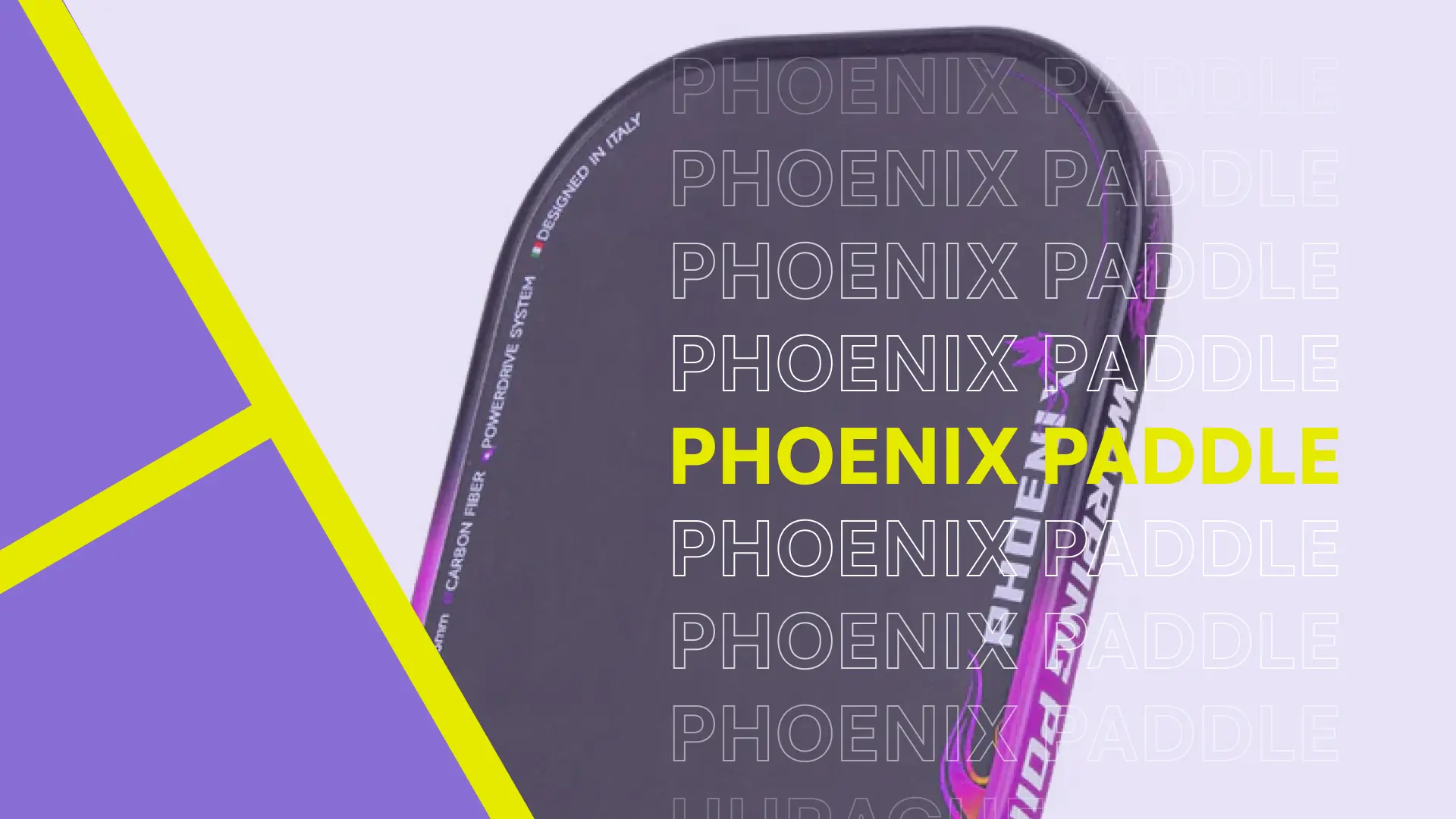
At 11 PICKLES, we play every paddle for real before we write a word. The first few sessions with anything new tell you nothing. You are still fighting the weight, learning the pocket, and missing the sweet spot, and everything you think you know will change by hour 10. This review is based on 40 hours with the Warping Point Phoenix 13.3mm over about a month of rec games, drilling, and league nights.
My daily driver is the Hurache X Alpha Pro Power, a $199.99 paddle with a 113 to 115 swing weight. I am a 4.0 player with a control-first style and the ability to bang when the point asks for it. I name those two reference points upfront because every paddle review is relative to what you are coming from, and the Phoenix is a very different animal from the plush, dwelly Hurache.
The short version: I expected the 13.3mm Phoenix to be a one-dimensional power bat, and it is more than that. It is slightly poppy, but the real story is the core, which gives you controllable power instead of just a loud face. I could swing through speedups and still drop my dinks back into the kitchen. The usual knock on a thin-core power paddle is that you give up touch and forgiveness. That was not my experience, and I will get into why.
Disclosure: Warping Point sent us this Phoenix to review. We were not paid for the review and only earn through our discount code "11pickles" for 10% off. Every opinion below is from 40 hours on court.
The Phoenix 13.3mm Scorecard
Here is where the Phoenix landed for me after 40 hours, scored from a 4.0 control-first player's perspective. These are my numbers, not a lab's.
- Power: 4.5 / 5
- Spin: 4.5 / 5
- Serve: 4.5 / 5
- Control and touch: 4 / 5
- Forgiveness: 3.5 / 5
- Value: 4 / 5
- Overall: 4.3 / 5
The Phoenix 13.3mm Is Slightly Poppy and Seriously Powerful
The first hit is loud. There is a clean ping off the face and a spring on contact that tells you immediately this is a power paddle. What I did not expect was where the power comes from.
A lot of power paddles get loud at the face and give you nothing underneath it. The Phoenix is the opposite. The pop sits on top, but the core is where the paddle earns its price. Warping Point calls it the PowerDrive System, a dense honeycomb wrapped in a TPE foam wall with an EFC edge wall around the perimeter, and on contact you feel the ball load into that core and come off with weight behind it. Put-aways had plow-through. Drives carried. Overheads felt like the paddle was helping.
The spin is the other headline. The Endura face grit is aggressive out of the box, and Warping Point lab-tests it at 2,100-plus RPM. That tracks with what I felt. My topspin rolls dipped harder than I am used to, and my slice serves bit into the court.
Here is the honest version of the one knock on this paddle. The thin 13.3mm core gives you a smaller sweet spot, and the worry is that it gets hard to control on soft shots. In my hands, the touch held up. I could reset and dink at the pace I wanted, and I rarely felt the paddle running away from me. If you come from a soft 16mm control paddle, expect an adjustment period. If you have decent hands, you may find more touch here than the spec sheet suggests.
A Thinner Core Built for Speed and Spin
The Phoenix comes in 16mm and 13.3mm. I play the 13.3mm, and the thinner core is the whole personality of this paddle.
A thinner core rebounds the ball faster off the face. That is what makes counters, speedups, and drive exchanges feel so immediate. There is less dwell, more reaction, more pop. The tradeoff is real: the thinner core gives you a smaller sweet spot than the 16mm version, which is more forgiving but has less punch.
So the choice is genuine. If you live at the kitchen line and want maximum forgiveness on resets and blocks, the 16mm Phoenix is the safer pick. If you win points with pace, spin, and fast hands, the 13.3mm is the one. I am a 4.0 all-court player who likes to counter, and the 13.3mm fit my game better than I expected. The dimensions are an elongated 16.5 inches by 7.4 inches with a 5.6-inch handle, long enough for a two-handed backhand without feeling unwieldy.
How It Feels With Specific Shots
Dinks: Better than the spec sheet suggests. My first session, a few sailed while I learned the pop. By session two my touch was back, and I could control cross-court dinks at the pace I wanted. The core does more work here than the thin profile would imply.
Third shot drops: Solid once I recalibrated. The thinner core rebounds faster, so you commit to a slower, shorter stroke or the ball floats. Once I trusted it, drops were repeatable.
Resets: I do a really good job resetting with this paddle. If I am nitpicking, I would take a touch more pop on the reset, but it holds up when I get jammed and pulled off the line.
Speedups: The best shot in the paddle. The pop and spin together let you shape a speedup with real pace off a dead dink.
Counters: Excellent. The fast rebound off the thin core is built for hands battles. I was punching through balls I normally just block, which is where a 4.0 counter game wants to live.
Serves: A real weapon. I win a lot of points outright off my serve with this paddle. The pace and the Endura grit make my topspin serve jump and my slice serve stay low.
Overheads and put-aways: Authoritative. Clean contact punches the ball into the floor.
A Word on the Labubu (Yes, Really)
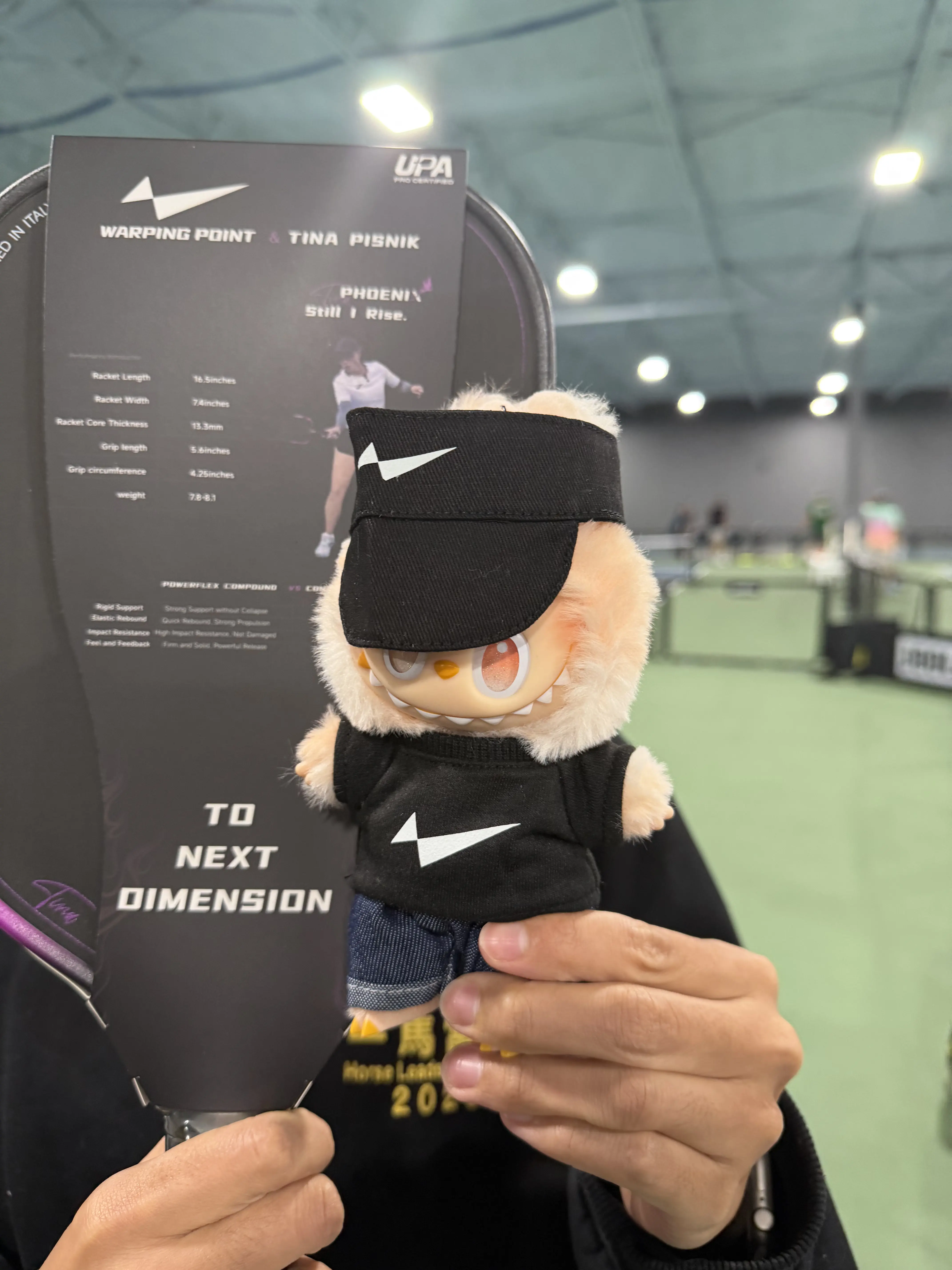
I was genuinely surprised when Warping Point told me I would get a special-edition gift with the paddle. It turned out to be a Labubu dressed up in jeans and a Warping Point Phoenix logo t-shirt, displayed on a little riser that also carries the logo. It is a small, fun touch, and I would never tell you to buy a paddle for a vinyl toy. But it is a nice signal of where this brand is right now. They are scrappy, having fun, and spending on the experience instead of only the marketing budget. Promotions like this come and go, so do not count on a Labubu in your box. Watch for their launch drops if the extras matter to you.
The Pro Behind the Paddle: Tina Pisnik
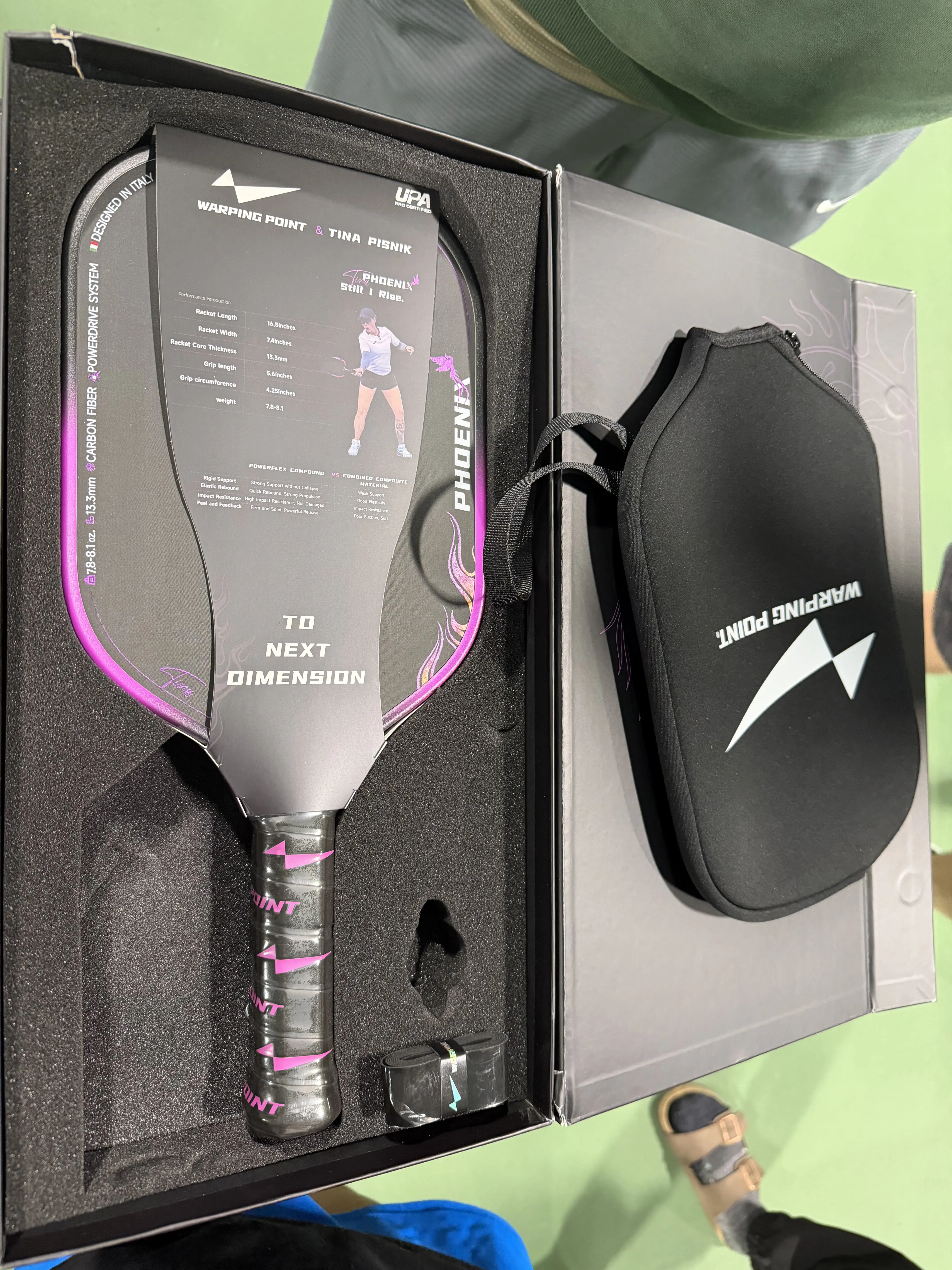
The Phoenix is not a paddle with a pro's name stickered on after the fact. It was co-designed with Tina Pisnik, and her game is all over how it plays.
Pisnik is a former WTA tennis player from Maribor, Slovenia, who peaked at world No. 29 in singles and was a two-time Olympian for Slovenia at Sydney 2000 and Athens 2004. She switched to pickleball and, in April 2025, became Warping Point's first-ever signed professional. Warping Point built the Phoenix around her, and she debuted it at the 2025 PPA Veolia Lakeland Open, where she and partner Kate Fahey took Women's Doubles Bronze in the paddle's tournament debut.
One update worth knowing: on April 22, 2026, Warping Point and Pisnik wrapped up their one-year partnership on amicable terms, and the brand announced that the original Phoenix would become a limited-edition release. The paddle is still the one Pisnik co-designed and competed with, so if you want it, it is worth checking current availability before it sells through.
Why that matters for your purchase: the Phoenix was designed by a former tour-level tennis player who generates her own pace and lives on aggressive, spin-heavy ball. If that sounds like your game, this paddle was built for it. If you are a soft-hands, dink-and-reset grinder, the design philosophy is pointing the other way, and the 16mm version is the friendlier choice.
Price and Build Quality
The Phoenix 13.3mm lists at $219.99. With the 11pickles code, the Phoenix 13.3mm drops 10% to $197.99. This is not the sub-$100 value tier of the Warping Point Neon. The Phoenix is positioned as a flagship, and the build backs it up.
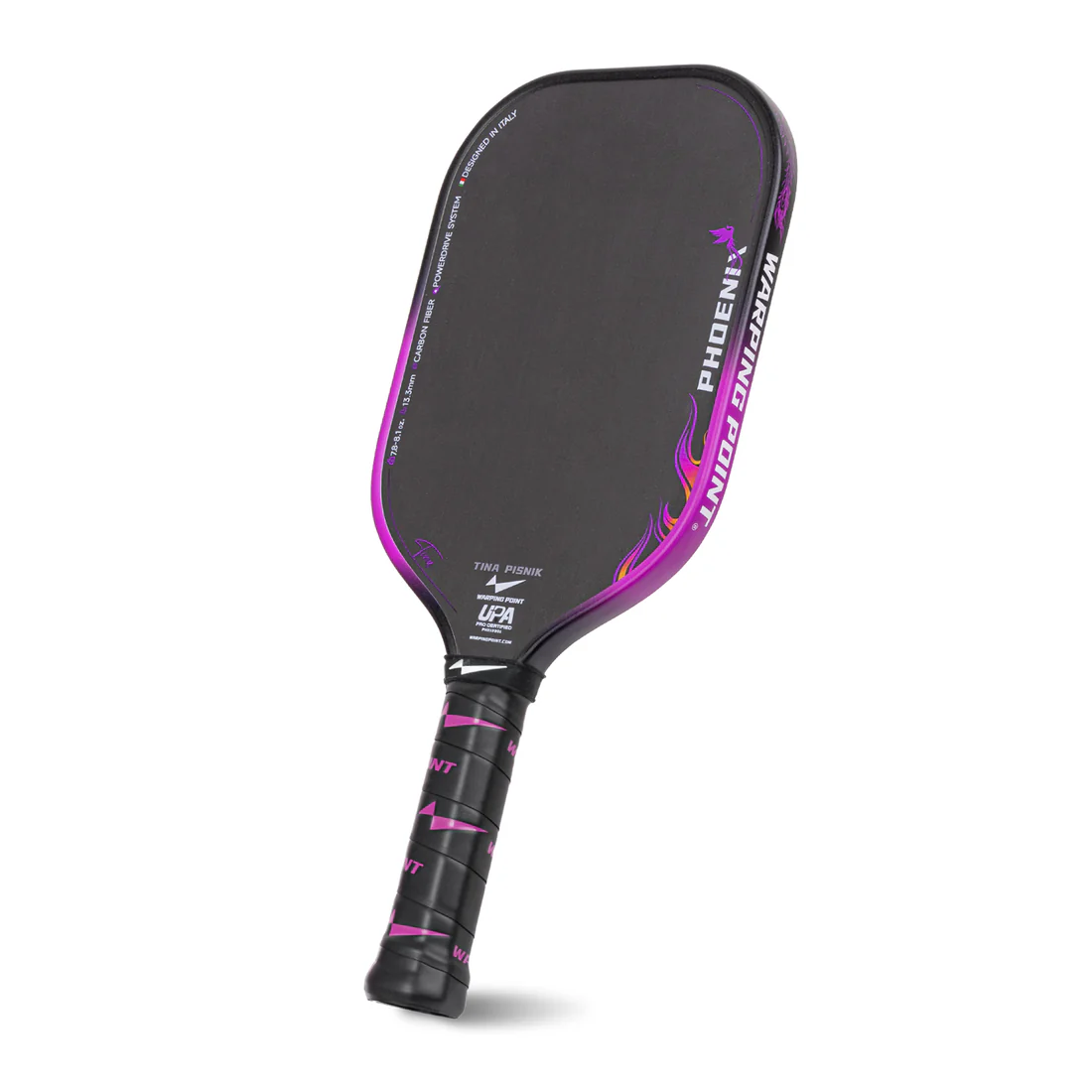
The face is raw T700 carbon fiber, triple-layered, the same carbon grade used on $250-plus paddles from Joola and Luzz. The core is the PowerDrive System: a dense honeycomb with a TPE foam wall and an EFC edge wall that ties the perimeter together. The Endura face has a fine-textured grit finish built for spin. The handle is a 5.6-inch octagonal bevel, long enough for a comfortable two-hander. Pull it out of the box and nothing reads cheap. It ships with a 30-day risk-free trial and a 1-year limited warranty on manufacturing defects.
Where you are paying a premium over the Neon is the thinner, more refined core and the spin-tuned Endura face. Where you are saving against Joola and Luzz is brand recognition and marketing spend, not materials.
How It Compares to Other Paddles
These comparisons draw on my own play test of each paddle.
Phoenix 13.3mm Vs. Warping Point Neon
The Warping Point Neon is the value sibling at $99.99, a 16mm hybrid with a big, forgiving sweet spot. The Phoenix 13.3mm is the flagship: thinner core, faster rebound, more spin, more put-away authority, smaller sweet spot. The Neon is the better first thermoformed paddle and the better value. The Phoenix is the better weapon if you have the hands to use it. It comes down to whether you want forgiveness (Neon) or pace and spin (Phoenix 13.3mm).
Phoenix 13.3mm Vs. Luzz Pro 4 Inferno
The Luzz Pro 4 Inferno is a $229 flagship power paddle with an MPP core and a 119.5 swing weight. The Inferno has a touch more raw plow-through on put-aways in my playtest. The Phoenix counters faster off its thinner core and spins the ball harder for me. Price is nearly identical, so this is a feel call. Bangers who set up and swing big may prefer the Inferno. Fast-hands counter players who win at the net will prefer the Phoenix.
Phoenix 13.3mm Vs. Luzz Pro Cannon
The Luzz Pro Cannon is the budget power option around $109. It out-prices the Phoenix by a wide margin and delivers serious raw power. What you give up is spin ceiling and the refined, foam-walled core feel of the Phoenix. If budget is the deciding factor, the Cannon is the value power pick. If spin and a more premium core are worth the step up, the Phoenix is the upgrade.
Phoenix 13.3mm Vs. My Hurache X Alpha Pro Power
Because I play the Hurache X Alpha Pro Power every day, this is the most honest comparison in the review. The Hurache is plush, dwelly, soft on resets, and built for a control game. The Phoenix is poppy, fast, and built for pace. For my control-first style, the Hurache is still my daily driver. But on the days I want to play offense and end points early, the Phoenix is the more fun paddle to pick up, and the spin is a clear step up.
The Tech Specs
- Price: $219.99 (with 11PICKLES code: $197.99)
- Weight: 7.8 to 8.1 oz (midweight, stated range)
- Core: 13.3mm PowerDrive System, honeycomb with TPE foam wall and EFC edge wall
- Face: Triple-layer raw T700 carbon fiber with Endura spin finish
- Spin: Lab-tested at 2,100-plus RPM
- Shape: Elongated (16.5 inches by 7.4 inches)
- Handle length: 5.6 inches
- Grip circumference: 4.25 inches
- Grip shape: Octagonal
- Certification: UPA-A certified
- USAP approval: Not on the USAP approved paddle list
- Warranty: 1-year limited (manufacturing defects), 30-day risk-free trial
A few specs are worth a closer look.
The PowerDrive core. The foam-walled honeycomb is what separates the Phoenix from a flat one-note power paddle. The wall stiffens the perimeter and channels energy back through the middle, which is why the paddle felt powerful and controllable at the same time.
Weight variance. The stated range is 7.8 to 8.1 oz. For this tier, that is a wide spread. The unit I played felt mid-range. If precise weight matters to your game, order from a retailer that hand-weighs before shipping.
The thin-core tradeoff. At 13.3mm you are trading sweet-spot size for speed and spin. If you want forgiveness over pace, the 16mm Phoenix is built for you.
UPA-A Certified But Not USAP Approved
This is the most important caveat in the review. The Phoenix 13.3mm is certified by UPA-A, the governing body for the PPA Tour, MLP, and all UPA-sanctioned events. It is not on the USA Pickleball approved paddle list, which in 2026 remains the standard for most sanctioned amateur tournaments.
If your tournament circuit runs under USAP, the Phoenix is not legal for your events. If your circuit runs under UPA-A, you are clear. For open play and rec ball, none of this matters. Confirm with your tournament director before you buy if you are unsure which body sanctions your events.
Durability and Build After 40 Hours
- Face grit: Holding strong. The Endura texture has kept its spin signature through 40 hours.
- Edge guard: A few surface scratches from court drops. No chips, no delamination, no looseness.
- Handle: Tight, no twisting, no foam detachment at the butt cap.
- Paint: Minor edge chipping where the paddle has taken hits. An edge guard tape will preserve it if that matters to you.
The paddle ships without a cover. A neoprene cover is worth the $15 to protect the face in your bag.
So What's the Verdict?
The Warping Point Phoenix 13.3mm is a flagship power paddle that does not forget about feel. The PowerDrive core gives it controllable power, the Endura face puts heavy spin on the ball, and the thin profile makes it quick in hands battles. The surprise was the touch. I could dink and reset with it better than a thin-core power paddle has any right to let me.
Buy it if you are a 4.0-plus player who wins with pace, spin, and fast hands, if you are a tennis convert who generates your own power, or if you want Tina Pisnik's actual signature paddle and not a sticker job. Pass on it if you are a soft-hands dinker who lives on resets, if you need maximum sweet-spot forgiveness (look at the 16mm Phoenix or the Neon), or if you play a USAP-sanctioned circuit that requires USAP approval.
If you want to buy it, use the 11 PICKLES code 11PICKLES at checkout for 10% off.
About 11 PICKLES
11 PICKLES is a San Francisco-based pickleball brandrun by players who are on the court most days. We test every paddle for at least 20 hours before we publish, write honest reviews of paddles and gear, and run a pickleball apparel shop on Etsy.
Frequently Asked Questions
Is the Warping Point Phoenix 13.3mm a Good Paddle?
The Warping Point Phoenix 13.3mm is a flagship power-and-spin paddle co-designed with PPA pro Tina Pisnik. It uses a triple-layer raw T700 carbon face with an Endura spin finish and a 13.3mm PowerDrive core. In my 40 hours of testing it delivered controllable power, heavy spin, and a strong serve, with more touch on dinks and resets than a thin-core power paddle usually allows. The tradeoff is a smaller sweet spot, so it suits aggressive 4.0-plus players with good hands more than beginners.
What Paddle Does Tina Pisnik Use?
The Warping Point Phoenix is the paddle Tina Pisnik co-designed and competed with, available in 16mm and 13.3mm versions. She debuted it at the 2025 PPA Veolia Lakeland Open, taking Women's Doubles Bronze with partner Kate Fahey. Pisnik and Warping Point concluded their partnership on April 22, 2026, and the brand said the original Phoenix would become a limited-edition release.
What Is the Difference Between the Phoenix 13.3mm and 16mm?
The 13.3mm Phoenix has a thinner core that rebounds faster, giving you more pop, more spin, and quicker hands on counters and speedups, with a smaller sweet spot. The 16mm Phoenix has a thicker, more forgiving core with a larger sweet spot but less raw punch. Choose the 13.3mm for pace and spin, and the 16mm for control and forgiveness.
Is the Warping Point Phoenix Tournament Approved?
The Warping Point Phoenix 13.3mm is UPA-A certified, which makes it legal for the PPA Tour, MLP, and all UPA-sanctioned events. It is not on the USA Pickleball approved paddle list, so it is not legal for USAP-sanctioned amateur tournaments. Confirm eligibility with your tournament director before purchasing.
How Much Does the Warping Point Phoenix Cost?
The Warping Point Phoenix 13.3mm lists at $219.99. With the 10% 11 PICKLES discount code (11PICKLES) it drops to $197.99. The paddle ships with a 30-day risk-free trial and a 1-year limited warranty against manufacturing defects.
Affiliate Disclosure: Warping Point sent us this paddle to review and did not pay for the review. This piece contains affiliate links, and 11 PICKLES earns a commission when you purchase through them, at no additional cost to you. The 11PICKLES code gives you 10% off at checkout. All opinions are based on 40 hours of on-court testing.


.webp)